Here is a basic identification guide for those who are still new to the Lophophora genus. Enjoy and feel free to comment. Please note, my guide is based upon the Kaktusy - Lophophora Coulter edition (2005), and contains excerpts from this handbook. There is much controversy regarding the genus and classifications of sub species, but I feel this is by far the most efficient and up to date at this point in time.
OVERVIEW
Firstly, there are four natural species within the Lophophora genus:
- L. williamsii
- L. diffusa
- L. fricii
- L. koehresii
There is also one cultivar, not found in the wild:
- L. jourdaniana
And there is recent speculation (June 2008) about a new, miniature species, found in the wild and flowers when the crown is around 15mm diameter (see here for further information):
- L. alberto-vojtechii
SECTIONS
Kaktusy propose that the genus should be broken into the following two sections (and numerous reasons are given for this proposition, including alkaloid composition, habitat, hybridisation compatibility and macroscopic appearance):
- Diffusae (containing L. diffusa, L. fricii and L. koehresii)
- Lophophora (containing L. williamsii)
Section Diffusae information excerpted from Kaktusy:
Common features and characteristics of the section Diffusae:
Similar chemical composition of its alkaloid content, among which pellotinoids prevail. None of the species in the section is autogamous. The flowers have longer receptacle tubes. The epidermis is thin and vulnerable. The ribs are often diffuse or indistinct. If ribs are produced, they may reach up to 21 in old plants. No shallow podaria are formed on the ribs separated by transverse horizontal notches. The structure and shape of the roots are similar to the smooth and fine epidermis.
Section Lophophora information excerpted from Kaktusy:
Common features and characteristics of the section Lophophora:
Similar composition of alkaloids, with mescaline alkaloids prevailing. With few exceptions, the various forms of L. williamsii are autogamous. The epidermis is rather thick and tough, often with a purplish undertone. The ribs are distinct, straight or spiralled in a maximum number of 13. Typically, horizontal notches form in the ribs. Sometimes the areollae merge into a nearly unbroken line. The wool is sticky, solidifying into tough crests and staying on the plant for a long time. The roots typically have quite a rough texture.
SPECIES
L. williamsii is by far the most common species, stretching across most of the Lophophora habitat. This is commonly known as peyote, and contains various psychoactive compounds, the main and most active being mescaline. L. williamsii is also one of the easiest to identify. The distinctive ribbing in older specimens is usually vertical or spiralling, with most plants starting with five ribs and developing up to thirteen with maturity. Flowers are pale pink with shorter petals than the other sub species. All sub species will clump with age (though some individual plants tend to stay singular for their lifetimes), but L. williamsii forma caespitosa (seen in the central photo below) tends to pup at a very young age and can carpet a large area in its lifetime.
L. williamsii characteristics information excerpted from Kaktusy (page 32):
L. williamsii Characteristics:
Flattened or depressed, spherical plants with solitary to clustering stems; the ribs are distinct, only occasionally broken into podaria; the greyish green epidermis is of a firm nature and bears a thick layer of cutin and surface waxes. Flowers rather small with a short tube in pinkish white to richly pink hues. The pink cylindrical fruit bears the remnants of the perianth. Seeds black, distinct from those of the other species.
L. diffusa is a far rarer species named after its rib habit. It has diffuse ribs (meaning they are not clean-cut ribs as found in the L. williamsii sub species) which tend to have a somewhat 'pinecone'-like appearance with the rib pattern. The epidermis (skin) is a lighter green, bordering on a yellowish tinge. Flowers are very similar to that of L. williamsii, but can have a yellow/green/white colouring. The main compound found in L. diffusa is pellotine and mescaline levels are very low.
L. diffusa characteristics information excerpted from Kaktusy (page 14):
L. diffusa Characteristics:
A large, appressed, spherical stem; solitary to clustered growth; peculiar yellowish green soft epidermis; diffuse ribs, often broken into separate low podaria; off-white flowers with shades of yellow and rarely pink; cylindrical, white to dark pink fruits.
L. fricii has a rib structure very much like that of L. diffusa, but with an epidermis colour more like that of L. williamsii (darker green than L. diffusa). Flowers are very bright pink and are the main distinguishing point from L. diffusa.
L. fricii characteristics information excerpted from Kaktusy (page 26):
L. fricii Characteristics:
A flattened spherical species of solitary to markedly clustered growth and an immense diversity of features; the numerous ribs are conspicuous to absolutely diffuse; the colour of its thin epidermis varies from yellowish green to greyish green; flowers vary from nearly white to dark purple-pink; seeds are similar to those of L. williamsii at first sight, but differ in the shape of the hilium, which is reminiscent of a shark's maw, and in the texture of the testa.
L. koehresii is supposedly the smallest of the genus (or at least was, until the recent speculation about L. alberto-vojtechii), with a growth habit very similar to that of L. diffusa. Flowers are light pink, but have much longer petals with pointed tips.
L. koehresii characteristics information excerpted from Kaktusy (page 20):
L. koehresii Characteristics:
Dwarf, depressed spherical, solitary species with a marked dark green epidermis; does not sprout spontaneously in the wild; the initially distinct ribs later break down, sometimes almost disappearing and transforming into low podaria; flowers large with mostly long and narrow petals, the white to pink colouring supplemented with brown stripes shading from the outer petals inwards, and making a characteristic colour combination; unusual spherical fruits with the remnants of the perianth shed before it ripens; the seeds are largest of all lophophoras with a very characteristic testa.
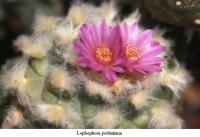
L. jourdaniana is thought to have been a cross breed between a Lophophora and possibly Turbinicarpus. It is only found in human cultivation, and as such is classed as a cultivar. It is the only sub species to have small spines (others only have tufts of wool at each areole, but may have very small spines at a young age). Flowers are a dark magenta-pink. This species is very rare and is not thought to be found in Australia at this point in time.
CONCLUSION
I guess all in all, the easiest way to ID the Lophophora species is that L. williamsii has very distinct ribs, while the other species are hard to tell apart without a flower. It might also be noted that there is visible difference between the sub species in the seedling stage - the cotyledons (seed leaves) tend to be slightly differently shaped, though L. diffusa, fricii and koehresii are all very similar (as are the mature plants) - which can give you a bit of a clue when differentiating between the sub species, but I wont go into that now.
REFERENCES
All pics were borrowed from here without permission. Please have a look there for more brilliant photos of the Lophophora genus and almost every other within the Cactacae.
Information about the Kaktusy 2005/2 Genus Lophophora Coulter. booklet can be found here.
Cheers,
Ace
Updated (March 2009) to include detailed excerpt from Kaktusy.

Question
Ace
Here is a basic identification guide for those who are still new to the Lophophora genus. Enjoy and feel free to comment. Please note, my guide is based upon the Kaktusy - Lophophora Coulter edition (2005), and contains excerpts from this handbook. There is much controversy regarding the genus and classifications of sub species, but I feel this is by far the most efficient and up to date at this point in time.
OVERVIEW
Firstly, there are four natural species within the Lophophora genus:
- L. williamsii
- L. diffusa
- L. fricii
- L. koehresii
There is also one cultivar, not found in the wild:
- L. jourdaniana
And there is recent speculation (June 2008) about a new, miniature species, found in the wild and flowers when the crown is around 15mm diameter (see here for further information):
- L. alberto-vojtechii
SECTIONS
Kaktusy propose that the genus should be broken into the following two sections (and numerous reasons are given for this proposition, including alkaloid composition, habitat, hybridisation compatibility and macroscopic appearance):
- Diffusae (containing L. diffusa, L. fricii and L. koehresii)
- Lophophora (containing L. williamsii)
Section Diffusae information excerpted from Kaktusy:
Section Lophophora information excerpted from Kaktusy:
SPECIES
L. williamsii is by far the most common species, stretching across most of the Lophophora habitat. This is commonly known as peyote, and contains various psychoactive compounds, the main and most active being mescaline. L. williamsii is also one of the easiest to identify. The distinctive ribbing in older specimens is usually vertical or spiralling, with most plants starting with five ribs and developing up to thirteen with maturity. Flowers are pale pink with shorter petals than the other sub species. All sub species will clump with age (though some individual plants tend to stay singular for their lifetimes), but L. williamsii forma caespitosa (seen in the central photo below) tends to pup at a very young age and can carpet a large area in its lifetime.
L. williamsii characteristics information excerpted from Kaktusy (page 32):
L. diffusa is a far rarer species named after its rib habit. It has diffuse ribs (meaning they are not clean-cut ribs as found in the L. williamsii sub species) which tend to have a somewhat 'pinecone'-like appearance with the rib pattern. The epidermis (skin) is a lighter green, bordering on a yellowish tinge. Flowers are very similar to that of L. williamsii, but can have a yellow/green/white colouring. The main compound found in L. diffusa is pellotine and mescaline levels are very low.
L. diffusa characteristics information excerpted from Kaktusy (page 14):
L. fricii has a rib structure very much like that of L. diffusa, but with an epidermis colour more like that of L. williamsii (darker green than L. diffusa). Flowers are very bright pink and are the main distinguishing point from L. diffusa.
L. fricii characteristics information excerpted from Kaktusy (page 26):
L. koehresii is supposedly the smallest of the genus (or at least was, until the recent speculation about L. alberto-vojtechii), with a growth habit very similar to that of L. diffusa. Flowers are light pink, but have much longer petals with pointed tips.
L. koehresii characteristics information excerpted from Kaktusy (page 20):
L. jourdaniana is thought to have been a cross breed between a Lophophora and possibly Turbinicarpus. It is only found in human cultivation, and as such is classed as a cultivar. It is the only sub species to have small spines (others only have tufts of wool at each areole, but may have very small spines at a young age). Flowers are a dark magenta-pink. This species is very rare and is not thought to be found in Australia at this point in time.
CONCLUSION
I guess all in all, the easiest way to ID the Lophophora species is that L. williamsii has very distinct ribs, while the other species are hard to tell apart without a flower. It might also be noted that there is visible difference between the sub species in the seedling stage - the cotyledons (seed leaves) tend to be slightly differently shaped, though L. diffusa, fricii and koehresii are all very similar (as are the mature plants) - which can give you a bit of a clue when differentiating between the sub species, but I wont go into that now.
REFERENCES
All pics were borrowed from here without permission. Please have a look there for more brilliant photos of the Lophophora genus and almost every other within the Cactacae.
Information about the Kaktusy 2005/2 Genus Lophophora Coulter. booklet can be found here.
Cheers,
Ace
Updated (March 2009) to include detailed excerpt from Kaktusy.
Edited by AceLink to comment
Share on other sites
Top Posters For This Question
12
10
8
7
Popular Days
Jul 29
9
Jul 31
6
Aug 5
5
Aug 3
4
Top Posters For This Question
trucha 12 posts
Ace 10 posts
kadakuda 8 posts
teonanacatl 7 posts
Popular Days
Jul 29 2008
9 posts
Jul 31 2007
6 posts
Aug 5 2007
5 posts
Aug 3 2007
4 posts
Popular Posts
Ace
Here is a basic identification guide for those who are still new to the Lophophora genus. Enjoy and feel free to comment. Please note, my guide is based upon the Kaktusy - Lophophora Coulter edition (
Ace
Thanks Teo I have updated the key to include your flower colouring info. Sabre: I have started grafting all Loph sub species (bar L. fricii, which I have not yet aquired seeds). Like you pointed ou
teonanacatl
fricii has major pellotine and minor mescaline caespitose williamsii has pellotine, anhalidine, anhalonidine, anhalamine and lophophorine as a nonphenolic alkaloid.
Posted Images
60 answers to this question
Recommended Posts